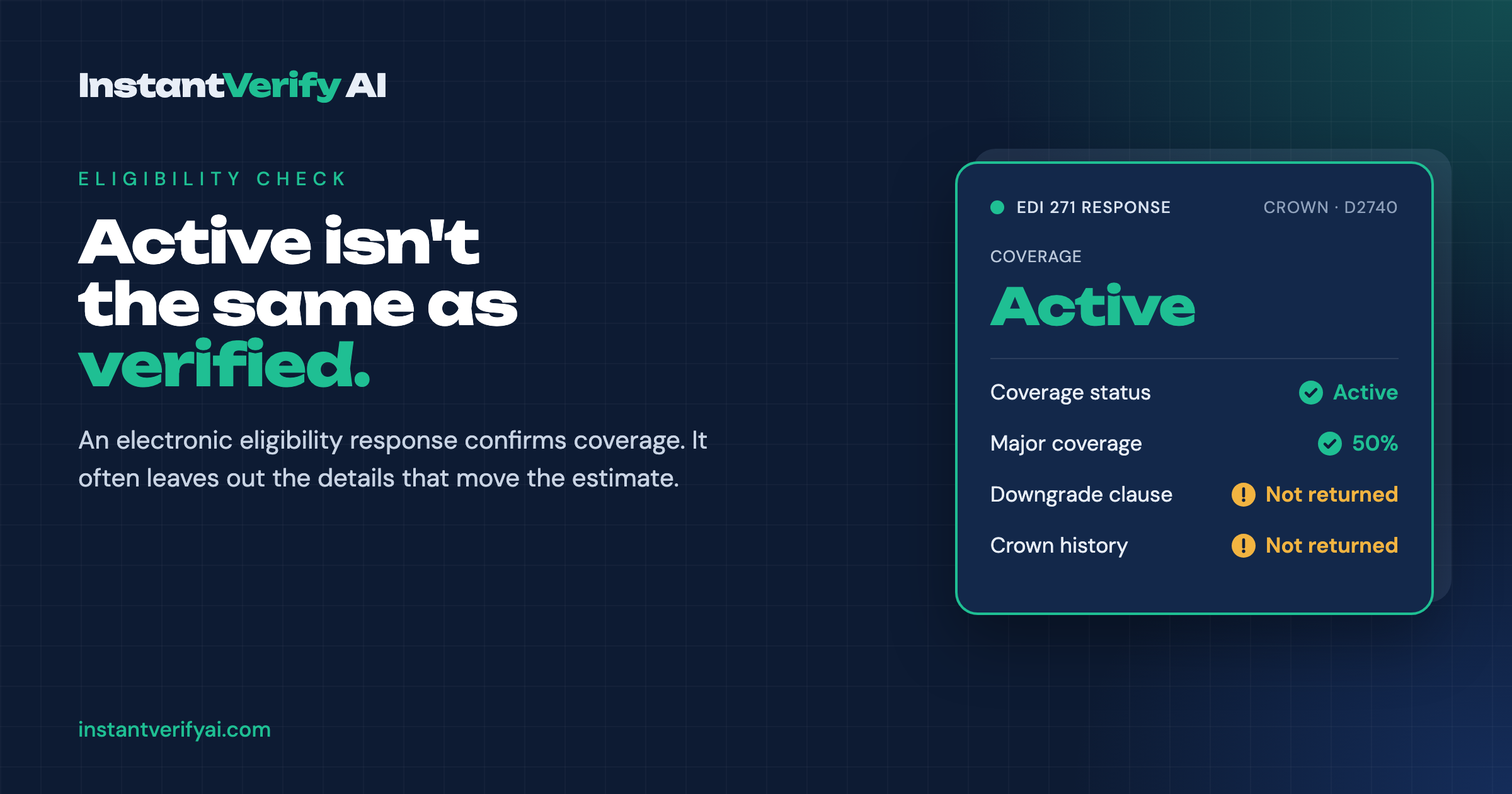
The check that comes back green
Most practices run an electronic eligibility check before appointments. It is fast, it is cheap, and it usually comes back with a reassuring answer: coverage active.
That answer is true. It is also where a lot of estimate problems begin, because "active" answers one question and the treatment plan depends on a dozen others.
A patient scheduled for a molar crown is covered. The office knows that much. What it does not know from a basic electronic response is whether the plan pays porcelain at the metal rate, whether that tooth had a crown four years ago, or whether a waiting period on major services is still running.
What EDI eligibility is
Electronic eligibility runs on a standard pair of transactions. The practice or its clearinghouse sends a 270 inquiry. The carrier sends back a 271 response.
The standard gives carriers a common structure for reporting benefits. What it does not do is guarantee that every carrier fills in the detail a dental office needs. What comes back varies widely from one payer to the next.
Some responses are reasonably complete. Many are thin: coverage status, plan dates, a few coverage percentages by category, perhaps a deductible and maximum. Some carriers return little more than confirmation that the patient exists. And some inquiries get no usable response at all, which sends the team straight back to the phone or the portal.
What tends to be missing
The fields that most often go missing are the ones that move the estimate.
- Frequency limits and history. How often the plan pays for a procedure, and what the patient has already used.
- Alternate benefit clauses. Whether a posterior composite is paid as an amalgam, or a porcelain crown at the metal rate.
- Waiting periods. Whether a new plan will pay for major or basic services yet.
- Missing tooth clauses. Whether the plan excludes replacing a tooth lost before coverage began.
- Procedure-level exceptions. Age limits, per-tooth rules, and codes that are covered differently from their category.
A response can have every percentage filled in and none of these. On the screen, it looks like a complete verification. It is a partial one.
Why the portal is different
Carrier portals were built for providers who need to know what a plan will actually pay. That is where the benefit detail tends to live: the limitations, the procedure notes, the claims history, the provisions that do not fit into a standard eligibility response.
The trade-off is time. Every carrier's portal is organized differently. Finding the downgrade provision or the frequency history can take several screens, and doing it for every patient on a full schedule is exactly the work that gets skipped when the front desk is busy.
That is why so many offices end up with a hybrid that satisfies no one. An electronic check for everyone, a portal lookup or a phone call when something looks off, and a hope that the gaps show up before the EOB does.
Electronic first, not electronic only
None of this makes EDI useless. It is a fast way to confirm that coverage is active and that the plan on file is the right one. For a simple visit, that may be most of what the office needs.
The problem is treating it as the whole verification. The deeper the procedure, the more the estimate depends on detail that electronic responses often leave out.
Good verification reads the portal where it matters, focused on the procedure that is actually scheduled. It pulls the frequencies, downgrades, and waiting periods that a crown or an implant depends on, and when a field cannot be confirmed, it leaves the field blank and flags it rather than filling in a guess.
"Active" is the start of a verification. It is not the end of one.
InstantVerify AI helps dental practices automate insurance verification, eliminate missed fields, and deliver confident benefit estimates every day. Learn more →
Get the Tuesday newsletter
One short email a week about dental insurance verification and front desk life. Unsubscribe anytime.